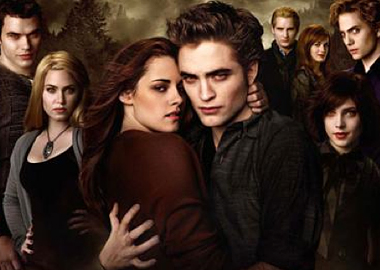
Chastity is hot. At least it is for many of the millions of Twilight fans, eagerly devouring the saga in book form and onscreen. The newest cinematic installment, based on the second book New Moon, opened just before Thanksgiving and is raking in millions.
In the capable hands of author, mother, and BYU alum Stephenie Meyer, chastity is charged with sexual excitement. In the first book the two main characters, Bella (the human) and Edward (the vampire), lurch back forth on her bed, in the forest, at school; they stare into each other’s pining eyes, wanting nothing more than to embrace one another in their eternal teen crush. And the temptations persist.
But herein lies the problem.
As a vampire, Edward’s desire to consume his human love verges on the literal: a brush too close or a kiss that lingers too long could override his better judgment and trigger his animal thirst for sex/blood! Bella, meanwhile, waffles between self-assured maturity and complete helplessness at the hands of one of most sentimental boy crushes of recent literature. Yet the stakes for her are much higher. As critics have pointed out, sex would mean death for the suffering heroine, but not for the stunning male lead, already locked into immortality. Even without the vampires, it’s surely enough to strike terror into the hearts of parents, teachers, guidance counselors, and feminists everywhere.
It has become commonplace to underscore Meyer’s Mormon background and thus, naturally, her promotion of chastity in Twilight—in The Atlantic, for example, Caitlin Flanagan tied Meyer’s Mormon faith to the “erotics of abstinence” portrayed in the novels. But is this new, sexy approach to chastity and moral purity the only Mormon manifestation to be found here?
There is definitely something Mormon about Twilight, but it’s not the focus on chaste teen love alone. More than the superhuman desire to control the teenage sexual libido, Meyer’s chronicle also draws upon much older, if somewhat less sexy, Mormon themes of eternal marriage and family life.
Of Meyer, Mormons, and the Eternal Family
Shades of Mormon theology arise quite clearly in Bella’s fixation on the vampire Edward’s “eternal family.” According to Mormon theology and practice, when a couple marries in a Temple wedding, they are bound together for all eternity, a ceremony that takes place in what is called a “sealing room.”
Sealing rooms usually have mirrors on two facing walls, so that as the couple kneels together, they can see themselves and the members of their family reflected back and forth upon each other over and over, a visual metaphor indicating that they are joined for all eternity. Any children born of a marriage sealed in a Temple are sealed to the parents for all time. Should a couple have children before they are sealed (perhaps because the children were born before joining the LDS church), the entire family can still become sealed, by all entering the sealing chamber together.
Sealing is extremely potent theological stuff. While a seal can be dissolved in the case of divorce, it is not an automatic byproduct of civil divorce. Additionally, it is one of the few places in contemporary Mormonism where one can still see the imprint of polygamy: while a woman can only be sealed to one man, men can be sealed to multiple women. A divorced or widowed woman cannot then be resealed, unless she has her initial seal dissolved in the case of divorce. A man, however, can be sealed multiple times, the ceremony remaining available to him despite divorce or the death of his wife.
Bella and Edward’s Eternal En-sealment
The Twilight saga reproduces elements of this theology through the language of eternity that echoes through Edward and Bella’s relationship. Early on in the third volume, Eclipse, for instance, Bella muses over how to describe Edward:
“The word boyfriend had me chewing on the inside of my cheek with a familiar tension,” she worried. “It wasn’t the right word at all, not at all,” she searched: “I needed something more expressive of eternal commitment.”
Underpinning Edward and Bella’s relationship is their eventual, if begrudging, agreement that if she marries him he will turn her into a vampire, thus allowing them to live together for eternity. This language of eternal marriage repeats as the dominant descriptor of their relationship, closing out each of the books. Twilight ends, finally, when Bella tells Edward:
“I love you more than everything else in the world combined. Isn’t that enough?” To which Edward responds, “Yes, it is enough… Enough for forever.”
In New Moon, the narrative ends with the observation that Edward is Bella’s destiny, walking alongside her. And in Eclipse the last line from Bella’s perspective records the moment of engagement: “He once again slid my ring into place on the third finger of my left hand. Where it would stay—conceivably for the rest of eternity.” The entire series ends with the observation that they can practice their mental intimacy “forever and forever and forever” before they move on to the physical intimacy that Bella describes in the last sense of the book as a “small but perfect piece of our forever.”
Vamping Up Marriage
Importantly, just as eternal sealing is an element of Mormon marriage, marriage is the key element for Bella’s eternal life as a vampire. Bella must be married to Edward before he is willing to “change” her. In the books, this condition is set for two reasons. First, Bella does not want to marry young. She does, however, want to be frozen, eternally young, so as to be about the same age as Edward in their immortality. But Edward fears that Bella is more interested in immortality than in him. He figures he needs a bargaining chip to convince Bella to marry him, and therefore refuses to turn Bella into a vampire until after he has turned her into “Mrs. Cullen.”
Second, Bella wants both to experience sex as a human and become a vampire as soon as possible. Her fanged beau has other designs. A self-professed traditionalist, Edward feels that his own virginity is the one place where he has not besmirched his own soul (if he still has one), and proves intent saving himself for marriage. Because Edward refuses to engage in either premarital sex or premarital vampire creation, they agree that Bella will cease to be human shortly after their honeymoon.
Here we see how the text links marriage to immortality. Bella becomes immortal—and the couple becomes permanent—through the act of marriage, just as the family becomes immortal through the sealing of the Mormon marriage rite. The sense that one will be in love with one’s teenage love for all time is certainly a familiar sentiment. While the language of eternity echoes the idea of Mormon celestial marriage, the theme might not be worth emphasizing if it were not coupled with another key aspect of the Mormon understanding of eternity: Bella is almost as interested in joining Edward’s family as she is in him.
Normalizing Family Values, Forever
The Cullen family is a gathered (i.e., non-biological) family of vampires who’ve sworn off killing humans, instead feeding only on animals (within the series, they refer to themselves as “vegetarian vampires”). Esme and Carlisie Cullen present themselves as young parents with five adopted children, in two sets of teenage siblings. As everyone in their high school knows, two of the three Cullen children are romantically involved with their foster siblings. Despite the fact that all of the vampires (except Edward) live in romantic pairs, they still describe themselves as a family made up of parents, brothers, and sisters. The rhetoric of family carries through all the books, with Bella constantly pondering her new family, or telling Edward that he has to accept that she cannot be protected from danger, because she is now part of the family.
Similarly, when Bella has to do difficult things, like act normal for the other humans despite the supernatural drama surrounding her, the vampires remind her that acting normal is part of what it means to join the Cullen family. The fact that the Cullens are a family—as well as, or even rather than, a coven (the normal designation for vampires: a gaggle of geese, a coven of vampires)—is a notable and important distinction in the vampire world. As the nomadic vampire Garrett observes in the final book, the Cullens, against their very vampire nature, have intense family binding. And just as in the familial connections created by Mormon sealing, when Bella becomes a vampire, she is as much part of the Cullen eternal family as she is Edward’s eternal wife.
The perfection of the Cullen family, in which everyone is powerful and beautiful (and the familial bonds eternal) contrasts sharply with Bella’s original human family. Though Carlisle and Esme, the Cullen parents, are not terribly old (in human years) and Edward is older than Esme (in vampire years), the Cullen parents are the strong and capable center of the family. Bella’s parents, on the other hand, are friendly but divorced. Her mother, Renee, is portrayed as the flighty child-woman who needs to be raised by her own daughter. Bella’s father Charlie acts more the adult, if an emotionally withdrawn one, yet he still hasn’t learned not to put metal in a microwave. In the end, Bella chooses to live with her father while allowing her mother to pursue a second marriage. Yet she ultimately chooses not even her father, but rather her boyfriend and his new family.
Bella laments the fact that she may have to leave her biological parents behind upon entering the vampire world (this turns out not to be the case, lucky enough for her), yet she’s no less willing to give them up for the promise of her new, eternal family. Still, new worries of mortality arise. When Edward and Bella produce a child, the unfortunately named Reneesme (Renee + Esme), they both worry that she won’t live forever along with them, as the child is half human, having been born before Bella’s transformation. But not to fear, for in Meyer’s fan-pleasing hands, Reneesme will indeed grow to adulthood and cease to age, living forever with her vampire clan—sealed in her eternal family.
Perhaps it would be too much to say the theme of the eternal family makes Twilight a distinctly Mormon series. But the tweens sure to flock to New Moon in the coming weeks, eager to be titillated by Bella and Edward’s as yet unfulfilled love, will also consume trace amounts of Mormon theologies of the family recast through vampire lore. And if fan devotion means anything, their love for this pop-Mormon vampire saga is nothing but forever.