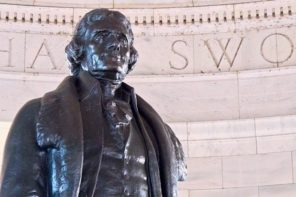
President Barack Obama’s plan to more or less continue the White House Office of Faith-Based Initiatives, an innovation of the George W. Bush years, represents a gesture of confidence in the ameliorative efforts of religious groups, as well as a political sop to evangelicals and other religious voters. But it also flirts dangerously with Thomas Jefferson’s “wall of separation” between church and state, opening the possibility for all sorts of First Amendment mischief.
It also represents a failure of imagination.
On the face of it, there’s nothing wrong or unconstitutional about using taxpayer money for “faith-based initiatives.” The rationale behind the program was that religious organizations are better equipped to deliver goods and services than government bureaucrats. No argument there. But the experience of the past eight years also suggests that the disbursement of taxpayer funds can become politicized—perhaps inevitably so.
What happens, for instance, when a church or other religious group receives government money for the dispensing of services, builds those funds into its budget, and then fails to deliver politically? The withdrawal of those funds—or even the threat of withholding the funds—then becomes a powerful tool for ensuring that a pastor, for example, will deliver a bloc of votes for the regnant political party.
That sort of abuse can be monitored, but it requires constant vigilance. And I find it encouraging that Obama has appointed proven church-state watchdogs like Melissa Rogers, formerly of the Baptist Joint Committee, to the advisory panel for the Office of Faith-Based Initiatives. They will have their hands full to ensure that the system is not abused.
But the real sadness here is a failure of imagination on the part of the new president, whose stock has never been higher. Rather than using taxpayer funds for the dispensing of social services, the president should seize this moment to offer a new vision for social amelioration, one that is, at the same time, very old.
Historically, churches and other religious groups assumed responsibility for social welfare. To cite just one example, in almost any midsized or larger city in America you will find hospitals that still carry the denominational names of their founders: Iowa Methodist Hospital, Columbia Presbyterian Hospital, various Baptist hospitals and so on. “Mercy” was a typical name for Roman Catholic hospitals. This reflected the sense of responsibility that religious groups felt for those who were in need.
When the social ills of the Great Depression overwhelmed religious groups, the government—of necessity—stepped in, thereby relieving religious groups of that responsibility. Sadly, churches and other religious institutions never reassumed that role in society.
What if the new president stepped forward and challenged religious groups to come up with a plan to reassert their traditional roles in social amelioration: feed the hungry, clothe the naked, and care for those Jesus called “the least of these”? (I want to bracket health care out of this equation; those issues are far too large and intractable.) Moreover, these religious groups should reassume these responsibilities using their own funds, not taxpayer money.
The rationale behind this proposal is that religious groups, by virtue of their tax-exempt status, already receive what amounts to massive subsidies from the federal, state, and local governments. By not paying corporate or state or property taxes, these tax-exempt organizations are already provided with massive subsidies, money that must come from either a diminution of services or increased taxes from other sources.
So Obama’s challenge to religious groups across the nation would look something like this: Devise a plan to address the social needs of this nation using your own funds, not taxpayer money. Such a plan, of course, would have to be comprehensive and nondiscriminatory. And that part of the federal budget now allocated for such services would be reduced accordingly.
Imagine the effect! Rather than using their funds to stock clergy pension funds or to build still more megachurches and parking lots, churches and other religious groups would redirect their efforts toward nobler ends. And maybe, in so doing, they would rediscover their true mission.
Such a plan would avoid entirely the brambles of First Amendment issues. And it would indeed make for a true “faith-based” initiative, one infinitely superior to the program now in place.