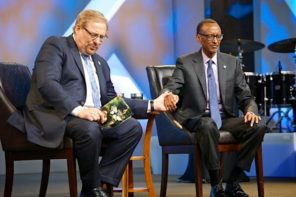
President-elect Barack Obama campaigned on a rather simple, but compelling promise. He would serve as a catalyst for change by helping citizens of the United States realize and act upon shared concerns. One might say Obama offered a new way of mapping life in the United States, one that privileged shared territory as opposed to the outlaying areas of exclusion and radical difference.
He noted this approach over and over again. And perhaps we heard this offer and found it appealing in light of the eight years of flat and unimaginative politics that preceded him. Yet, I am not convinced that we recognized the ramifications of this “truce,” particularly within the realm of religion and theologically-influenced viewpoints.
We lost our political innocence long ago; we hold few illusions with respect to the troubled nature of political give-and-take. However, it seems we expect something more firm and determined with respect to our religion(s). After all, for so many in this country, religion is based on moral and ethical postures grounded in some type of cosmic or communal concern that extends beyond the worst aspects of our individual inclinations. In many cases, sacred texts tested through time are said to guide and ensure the correctness of religious belief and practice.
Mindful of this, many heard in Obama’s words nothing that challenged the truth of their particular religious commitments and orientations. Some assumed the “other group” would shift, give something up. The compromise Obama implied would not go to the heart of their religious self-understanding; their theological claims and accompanying social assumptions would not be accosted in the process of working deals. What we have heard recently in some circles certainly suggests this stance: How could he pick for prayer someone whose religious sensibilities support the dehumanization of certain groups? How could Obama make such a concession; doesn’t he recognize the implications? These questions have come from many quarters—agnostics, atheists, liberal Christians, and so on.
Let me be clear: I personally reject Rick Warren’s theological orientation and vigorously critique the death-dealing theologies of many like him. I am opposed to conservative theological stances that demean, dehumanize, and limit life options. My writings over the years make this clear. My disagreement (and yours) is not the point, in the same manner that Obama’s personal disagreement with Warren’s views could not be the litmus test for inclusion in an event with importance for all citizens of the United States.
I understood what Obama’s call for common ground would entail long before I cast my vote for him. “Getting to Yes,” as some might name it, would involve a surrender of some ground (in this case theologically-grounded viewpoints and stances) for the sake of larger, productive work on rather significant issues.
This invitation, while distasteful in a variety of ways, is a clear sign of Obama’s commitment to compromise, to common ground. Yes, I know; an explanation for this viewpoint—coming from a religious humanist—is in order.
Here goes: Obama’s claim to be concerned with change, with the advancement of the country based on shared concerns and vision, had to be played out in more than the political arena. It also had to be true in terms of more privately arranged commitments—such as religion as a dimension of our collective culture. To accomplish this, Obama had to think about religion beyond strong distinctions and disagreements. Yet, in a country marked by graphic religious diversity and deeply entrenched religious pluralism, how does one mark out common ground? Is it even possible? The answer is Yes!
This answer requires a bracketing of superficial markers of religious belief and practice such as church attendance, particular rituals, and so on. Instead, one must look deeper, trying to grasp what religion seeks to accomplish in a more fundamental way. One might phrase it this way: What is the shared concern of religion evident beyond the explicit differences? It seems to me the answer is simple. Religion, at a fundamental level, is concerned with the search for life meaning—the effort to come to grips with the terrifying questions that confront us: Who are we? What are we? Does our existence matter? Rituals, doctrines, structures, and so on, are simply the way in which we dress up this more basic and shared wrestling with our ultimate significance. But it is this fundamental function that really defines what we should mean by religion, and it is the basic outline of the nation’s religious landscape.
There is no doubt but that there will be points of disagreement on the particulars, the details of faith and praxis; but, each religious tradition and each version of a given tradition is concerned with this basic quest for life meaning, for a way to make sense of our existence. And it seems to me it is this shared function that Obama taps by appealing to a variety of competing religious orientations. It is through this approach that Obama has the chance of harnessing the best of our shared vision for a better country, and exposing the most harmful dimensions of our beliefs.
So…
Theological disagreements will persist, as they should. And we will have opportunity to wrestle over these disagreements in that such ability to debate in the public arena is a hallmark of our socio-political culture at its best. But debate will not end disagreement. Rather, these vigorous exchanges provide opportunity for greater understanding. They afford a chance to more easily recognize the points of convergence and provide a vocabulary and grammar for arguing about the rest.
It is unreasonable to think President-elect Obama can or should resolve the conflict over religiously informed opinions when this very task has befuddled religious leaders for centuries. Obama will do well if he can help us make the tension between religious worldviews creative and an arena for fruitful exchange. What we can hope for is management of and respect for our religious differences and an attempt to map out ways to harness the energy of our shared quest for a greater sense of who, what, when, and where we are. And, in this way, we might tame the more harmful aspects of our religious and theological orientations. Will we achieve this taming of our more harmful theologically-fueled tendencies? Not likely, but it’s a task worth the effort regardless of the outcome.
Obama is making this effort, and the measure of his success isn’t the contentment of any particular group, but the ability of each group to voice its discontent and its disagreement, and to push a national conversation forward. Yes, dislike his selection for the invocation, and voice this dislike; but recognize that Obama’s call for common ground will mean not always getting what you want.