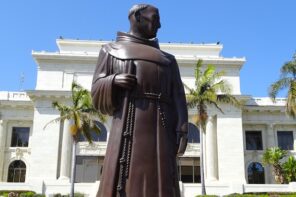
The Best and the Brightest of the Catholic Bad Girls
By Frances Kissling
June 15, 2009
  • 16 Comments
  • Print

We picketed bishops and Popes, stole their dresses, stood up at the consecration of the Eucharist and said the words out loud. We are the bad girls of Catholic feminism, and we have stood up, over and over again, for women’s freedom.

Original Bad Girl Sor Juana de la Cruz

How does power respond to those who want a place at the table? As Gandhi once explained, power has five strategies. First, it simply ignores those knocking at the door; when that fails, power pretends the seekers are only a few very unimportant and disgruntled people, not worthy of attention. If they manage to survive being ignored and marginalized, power attacks them either physically or verbally. Those who survive then find their goals and even identity co-opted. Finally change happens.

While I’ve never felt powerless, I have found reflecting on this analysis helpful in understanding the reaction of Catholic popes, bishops, and those who are part of the Catholic boys club to uppity Catholic women—I knew we’d finally gotten to them in 1998 when Sydney Callahan reported in Commonweal on a Vatican meeting on women where John Paul ll announced that he was the “feminist Pope.”

The declaration was a sign of the extent to which it had become unacceptable to dismiss, marginalize, satirize, or simply roll your eyes and trash feminism—and Catholic feminists. It was time for the church, at least in its clerical identity, to shape an acceptable form of Catholic feminism and to anoint some “good” Catholic women. Of course, the Vatican was the last place to recognize this need; political astute and worldly clerics (and laymen fellow travelers) had already recognized that in the cosmopolitan environments they wanted to move, the church’s misogyny as well as the nearly all-male institutions they were associated with were an embarrassment.

A Modern, Sophisticated Rectory Housekeeper

Some level of gender sensitivity and integration was necessary. But not too much, the church seemed to say, and not with women who make us uncomfortable: nice women, polite women, not pushy broads. It’d be especially helpful if they respected the priesthood. A modern, educated, and sophisticated version of the rectory housekeeper seemed to be what was needed.

Oh, and most importantly the church wanted women who didn't think they understood theology well enough to criticize it and get in trouble with the Vatican. After all, one cannot go around claiming that it is good theology that women are moral agents, capable of making good decisions about their nature, sexuality, and reproductive choices. Women like Catherine of Siena, Joan of Arc, and Juana de la Cruz need not apply. The good women wouldn’t be very interested in sex, other women, or power. They’d care about poverty, world hunger, development, and education. When it came to women’s lives, only women you could put the adjective “poor” in front of would deserve attention, and they wouldn’t make an issue of ordaining women to the priesthood. If they weren’t nuns, their personal lives would be a sign of goodness (if they were married and had kids) or hidden (if they were single). For the single ones their public persona was one of perpetual virginity, free to serve others and the church. No hint of sexuality about them. Good-looking Mother Teresas.

Bad Girls Don't Care About Men

With apologies to these women, because I have no desire to stereotype them (I have more in common with them than in conflict); Mary Ann Glendon, Mary Cunningham Agee, Helen Alvare, and now, Alexia Kelley, became the Good Catholic Girls. And, they were and are put up against the Bad Girls: Mary E. Hunt, Sr. Donna Quinn, Rosemary Ruether, and Agnes Mary Mansour, for example.

One of the major differences between the two groups is that the bad girls don’t care at all about the men. It’s not that we don’t like them—and we’re not all lesbians. It is just that their maleness and self-importance, their knowledge, Catholic wit, and PJ O’Rourke bad boy charm don’t impress us. We didn’t sleep with priests, we don’t go to them for advice on our personal woes, they are not our confessors or spiritual directors. We don’t invite them to speak at our conferences, and we don’t particularly think they are the best theologians. Moreover, you can’t count on them if you get in trouble. They barely get their act together to defend one of their own (like Charles Curran) and when women are attacked by the Vatican (like Jeannine Gramick on homosexuality or the Vatican 24 on abortion or Yvone Gebara in Brazil) not one of them will speak out. Some of us think they are cowards.

But enough about them.

This is about the best and the brightest of the bad girls (BBBG) who had their heyday in the 1980s and ’90s when Catholic feminists were radical feminists. The acronym BBBG comes from a talk Mary Hunt and I gave at a Chicago Catholic Women meeting in the 1980s. It was a time when Catholic women, members of religious communities and the rest of us, were thinking about hot button issues. We were so very different from the progressives in the new groups that have formed in the wake of the 2004 elections, particularly Catholics United and Catholics in Alliance for the Common Good.

We were seeking to redefine what it meant to be Catholic—as well as to change the world. We were Catholics in Resistance to injustice inside the church because we believed injustice inside the church led to public policy positions that hurt women. And many leading Catholics of that time were either pro-choice or recognized that one could be pro-choice. One could count on the fingers of one hand progressive Catholics who were actively anti-abortion (Richard McSorley, the Berrigans, Julie Loesch Wiley come to mind).

In the 1984 election, Catholicism and abortion was a big issue. Geraldine Ferraro, a pro-choice Catholic, was the Democratic nominee for vice president. Ferraro had written in the introduction to a briefing book prepared by Catholics for Choice for a congressional meeting that brought together about 20 pro-choice and pro-life Catholic members of Congress that “the Catholic position on abortion is not monolithic and there can be a range of personal and political responses to the issue.”

Then Cardinal O’Connor of New York attacked her. Catholic women’s groups mobilized and Ferraro was greeted at campaign rallies with signs that said “Catholics for Ferraro” and “Another Catholic for Choice”.

Ferraro, of course, was criticized by some male theologians and journalists for having the audacity to think she, a lay woman, could comment on theology. The comments then were similar to those made when Biden and Pelosi responded to media questions about their position on choice. Jesuit Tom Reese declared “Politicians should not do theology.” Chris Korzen of Catholics United judged Biden’s comments to be not only unwise but theologically incorrect. “As far as the church is concerned, doctrine is off limits. When public officials make those comments, of course the bishops need to correct that error.”

What, according to Korzen, was Biden’s doctrinal error? He had said that the church’s position on when life begins had changed over time and Thomas Aquinas had not considered the fetus to receive a soul at conception. In fact, Biden made no error of fact in his statement, although the information he cited is not convenient for the bishops who claim nothing on abortion has ever changed in the church. it is, however, Korzen whose theological knowledge is questionable.

A Diversity of Opinions

Catholic feminists and progressive theologians in 1984 reacted quite differently from Korzen. Rather than defending the flawed presentation of Catholic teaching articulated by the bishops and excusing the politicians’ pro-choice position by citing the good they did on other social justice issues, they defended Ferraro’s right to be pro-choice.

In a newspaper ad paid for by Catholics for Choice and published in the New York Times on October 7, 1984, Catholics (including 24 nuns, 2 priests, and 2 brothers) ran under the headline “A Diversity of Opinions Regarding Abortion Exists Among Committed Catholics” and argued that Catholic politicians who disagreed with the official position should not be punished.

Signers included nuns who were members of the National Coalition of American Nuns who had come out in favor of public funding for abortion in 1976. Prominent among them were Srs. Margaret Traxler, Marjorie Tuite, and Donna Quinn; the three had impressive histories of civil rights activism. Traxler had marched with Dr. King; opposition to US imperialism in Central America was Tuite’s passion and grassroots activism for women on welfare drove Quinn. Quinn and I shared some Grand Marnier at a Religious Coalition for Reproductive Rights organizing conference a couple weeks ago. While breathing in the fumes, she expressed disdain for the Notre Dame anti-Obama protest and remembered her own picketing of Reagan at Notre Dame. Sister Maureen Fiedler, who had fasted for the ERA and five other sisters of Loretto signed the CFFC ad as well.

Academic theologians Daniel Maguire (who co-wrote the ad, along with me and his then-wife Marjorie) and Rosemary Ruether were signers, as were Srs. Margaret Farley and the late Ann Carr. Farley, an ethicist, had analyzed the issue of sterilization in Catholic hospitals and rendered the opinion that ethics required the hospitals to offer the procedure postpartum, as it would subject women to greater risk if they waited and had a sterilization months later. The order was threatened with “receivership” by the Vatican if they implemented the opinion and they backed down.

The Vatican also threatened the signers of the NY Times ad and demanded the nuns, priests, and brothers retract or face dismissal from their orders. The men immediately requested that their signatures be removed. The nuns stood firm; only one requested her name be removed.

Complex negotiations ensued—most of the nuns wrote something reassuring to the Vatican and none were dismissed. They have by and large continued to be publicly pro-choice. Two were really bad girls and refused to give the Vatican anything. The Vatican backed down but Barbara Ferraro and Patricia Hussey, who ran a shelter for the homeless in West Virginia, were so disillusioned and angry that they left their order.

A few Roman Catholic nuns in public office took great risk to defend poor women and their access to abortion. Some would describe themselves as pro-choice, others would not. In 1982, Sister Agnes Mary Mansour was head of Michigan’s Department of Social Services where she monitored Medicaid funds for abortions. The Vatican demanded that she stop funding abortions or resign from her order. She resigned.

Sr. Elizabeth Candon was president of Trinity College in Vermont. In 1972, she let women meet on campus and plan Vermont’s first abortion clinic. In 1976 she defended the state's policy of paying for poor women’s abortions, and a few years later simply said that it was women who should make the decision about whether or not abortion was moral.

But BBBGs were not only open on the question of abortion, they challenged just about everything else, without regard for personal safety or future position. Sr. Teresa Kane was chosen to greet the Pope in DC in 1979. She used her remarks to politely and obliquely suggest women should be ordained. Sr. Jeannine Gramick became a passionate advocate for GLBTQ Catholics, conducting workshops all over the world. The Vatican ordered her to be silent and she refused. In 2002, seven Roman Catholic women defied the Vatican and found a bishop to ordain them. They now number 50 or so, have their own bishops and ignore Vatican decrees that they are excommunicated.

A lot of BBBGs got out of Catholic universities as fast as they could so they could say what they believe and teach freely. Elizabeth Schussler Fiorenza went from Notre Dame to Harvard and pointed out that Jesus never ordained anybody. Christine Gudorf left the University of Dayton for Florida International University, where she could say that the ethical standard for sexual relations was pleasure and justice, not marriage.

Mary E. Hunt, the baddest of all, just formed her own organization with her partner Diann Neu and took the right stand on everything: abortion, sex, GLBTQ, you name it.

Some BBBGs were unfailingly polite and worked the system as best they could. Farley, Carr, Kane, and Mansour come to mind. But the rest of us had no respect for authority. We picketed bishops and Popes, stole their dresses, stood up at the consecration of the Eucharist and said the words out loud. At Marge Tuite’s funeral—after the priest welcomed those of other faiths but told them not to take communion—we walked up and down the aisles and near dragged our friends out of their seats and up to the communion rail. Who ever heard of inviting people to dinner and not giving them anything to eat?

We are the “old” feminists; the ones the Vatican calls “exaggerated secular feminists”; the ones Ratzinger says sow discontent and hatred of men. The “new” feminists are all for the complementarity of men and women, and they stay in their place. They go to the Vatican; we go out to dance salsa together. And we stand up time and time again for women’s freedom. We are public witness to the fact that the hierarchy only has the power you give it. What are they going to do? Tear out our fingernails?

Don’t get me wrong, a lot of the good girls care about women, and being careful is not always a bad thing. We all have our theories of change; BBBGs tend to think it happens at the margins and the good Catholic girls, at least the ones who want change, think it happens at the top. Both are needed.

But the last thing we need are men telling us who’s a better feminist, never mind Catholic.

Tags: abortion, bishops, catholic, catholic church, catholics, feminism, pope, theology, vatican, women

Comments
View:
Turn comments off sitewide
The 1984 election...

... perhaps is not the best example of how attacking the Catholic church is a good way bring about positive progressive change.

http://cara.georgetown.edu/Presidential%20Vote%20Only.pdf

great!

This is a great article. I'm not incredibly familiar with the history of Catholic feminists, but I know a few and they're just as feisty as the ones you describe.

Also, Margaret Farley is amazing.

Kissling misses the mark, again

This is just more wedge-driving by Frances Kissling because she feels slighted by the Obama administration. Besides not understanding what it means to be a Catholic, she doesn't appear to understand the goal of finding common ground. She continues to assail Alexia Kelley as an agent of the church she despises, when, in fact Kelley has strived to bridge the divide and reach a new level of dialogue regarding abortion. Kissling thinks that is some kind of mindless conformity with church teaching, but it is something entirely different and fresh in the conversation.

It's time for the relics of the culture wars to change their language, abandon false dualisms or step aside so that those who sincerely want to make progress are not hampered by inflammatory language.

RE: Kissling misses the mark, again

Dear Anon - do you have a name or can you only attack anonymously? Do you have the courage to be held accountable for your views? This sound bite that you are using about my motivation in criticizing groups and individuals within the Catholic prolife common ground movement because I am feeling slighted by the Obama administration is unworthy. You don't even know me!
I criticize them because I have an excessively low tolerance for people and groups that do not have the courage to say publicly what they privately believe or know to be true. I am sympathetic as they do so out of desire to achieve a good goal. But I don't believe the risk to women's moral agency makes this a justifiable means to an end. Too many Catholics have paid the price for being honest on contraception and abortion to let Kelley, Korzen, et.al. get away with obfuscation. Numerous people have told me that these groups and their leaders are not anti-contraception but they won't say so publicly for political reasons. It is also impossible to believe that any theologically trained Catholic who is not part of an ultra traditional movement does not know that it is legitimate within the tradition to disagree morally -not just legally - with the institutional positions on issues from divorce, contraception, abortion to homosexuality. I expect a Catholic who respects other Catholics to be prepared to say that publicly. That is my motivation for criticizing and analyzing the statements of these groups and individuals. And I will continue to do so.People need know that you can be fully within the tradition of Catholicism and believe that abortion can in certain circumstances be a morally justifiable decision and right or wrong in any case, women have the moral right to make that decision. It is also fully within the tradition to believe that the use of artificial contraceptives is a morally correct and responsible decision. Any Catholic who has the privilege of a public voice and does not acknowledge that does a grave disservice to women -and men - working out a moral life. The demands of leading an ethical life are difficult to meet, but one of them is honesty in public discourse regardless of the consequences. Why is it so hard for you to believe that someone like me would have good motives for critiquing what they see as damaging and dishonest behavior?

I am uncertain why concluding my critique is based on personal shortcomings makes you happy - but that is your problem not mine. Perhaps it is because responding to the substance of the critique would require either lying about the right to dissent or alternatively telling the truth. I might be wrong about Korzen, Kelley, et.al - but frankly in spite of all your talk about reaching out, none of these folks has the courage to respond substantively to any questions about their beliefs, research, policy suggestions, etc.
I left CFC over two years ago because I wanted a different kind of life.I hated going to the Hill, the White House, that whole access thing. It made too many people into sycophants who took access to be the same as power. As you seem to understand, although misinterpret, the lure of access I would suggest that perhaps it is the access that comes from putting religion in the service of politics that is the problem, not any perceived need you think I have.
"relics of the culture wars" "abandon false dualisms" "step aside" so that those who want to make progress are not hampered by inflammatory language???? This type of stereotyping "old feminists" which discards people who disagree with you in the most derogatory of terms, so disrespectful of human dignity is the very reason articles like mine get written.That those like you who claim to be so motivated by respect and human dignity are always the first to degrade others is really sad.

RE: Kissling misses the mark, again

No, no, Ms. Kissling is spot-on.

I remember 1984 quite well, going through walls campaigning for Mondale-Ferraro.

As an italian Catholic married to anther Italian Catholic (born in Italy) I can tell you that most of my immediate friends and family who share my heritage -- especially the women, are strongly pro-choice. In fact, abortion in Southern Italy has been pretty widely practiced for ages.

Juana de la Cruz

There's a great movie about Juana de la Cruz, by the way: see here.

How about voting with our feet?

It seems that if women flocked away from the church, the powers that be would get the message and end centuries of sanctioned oppression. Come on, Girls, let's show them we mean business and stop supporting our own enslavement!

RE: How about voting with our feet?

Those, both women and men, who "think" the same way Kissling and other of her ilk do, have already "voted with their feet." They left the one, holy, catholic and apostolic Church. And the least they have to be concerned about is the Church tearing their fingernails out. They will reap what they sow in the next life, when confronted by their maker, they say their "consciences" impelled them to refuse to listen to Christ's vicar on earth or the constant ongoing teaching of the Church. Does "itching ears" ring a bell?
Also, please do not bring up the old Thomas Aquinas didn't know when life began. It's true, he did not, but even so, the Church has steadfastly been against procured abortions from the very beginning and remained against procured abortions during the time of Thomas Aquinas and is still against procured abortions to this day. (Read the Didache.) And, after all, how could the Church NOT be against procured abortion when the book of Genesis tells us that all human beings are made in the very image and likeness of God, the Psalms tell us that God has formed us in secret in our mother's womb, the Gospel of Luke tell us that John the Baptist leapt for joy in his mother's womb at the sound of the Virgin Mary's voice, and that the hypostatic union came into existence at Mary's fiat?

Is there a link to tradition here?

Ms. Kissling, I read your article with great interest as I am a graduate student doing research on the Catholic Church and international reproductive health norms, particularly in the Philippines. I admit that I am not terribly familiar with your writings or the work of modern Catholic feminists, so I ask you to please forgive me if my comment sounds naive.

Much has been made about whether Catholics who support the right to abortion are "truly Catholic" or not. I have seen this argument used against advocates of reproductive health (whether or not the conception of reproductive health includes the right to procure an abortion), people who voted for Obama, and so forth. While I consider such blanket criticism ham-fisted and unhelpful, it does tell me that certain people who consider themselves to be Catholic are seeing their faith--which is linked to morals--as under attack.

No doubt you are familiar with Peter Berger's notion of "plausibility structures"--those institutions and ideas held to be sacred that underpin a faith, and without which belief in the faith collapses. My sense is that those Catholics who react with anger to your views see their long-held moral norms as being undermined by foreign (i.e. non-Christian) ideology. Certainly there are powerful elements in the Church who regard radical feminism as incompatible with Catholicism. Cardinal Bernardin's "seamless garment" argument has also provided a powerful symbol for many Catholics--if the norm against abortion disappears, many would argue, then norms against suicide, the death penalty or eugenics would also be eroded. Where would it stop? On what principles would you base your morality? Moreover, how you can root a position that treats access to abortion as a fundamental right within Catholic tradition? After all, you are not coming at this issue from the perspective of an atheist but from that of a Catholic. Is there a scriptural basis for this? Is there some sort of other precedent for this? If not, then how would you propose making that connection?

Thank you and I look forward to your reply.

RE: Is there a link to tradition here? To Jonathan

Dear Jonathan - the rules of RD limit my reply to 4000 characters and I will not be able to answer your questions in that short space. I will make a few brief remarks and suggest some things to read. Daniel Maguire from Marquette, Tony Coady, an Australian Jesuit, and Daniel Dombrowski, a philosopher at Seattle U have all written on the issues you raise. Coady dealt with the question of why Catholics who accept birth control, homosexuality, and understand the right to dissent, non infallibility, primacy of conscience, objective vs subjective sin, probablism, the lack of consistency over time on the question of ensoulment of fetuses and thus difficulty of defining a moment of personhood theologically seems to concur with Berger. He says these liberal Catholics have a concern that if they don't hold out on something in the moral area, and abortion has been the issue on which Catholics who disagree with the church get most isolated by the Vatican and US bishops - then what could they point to that makes them different from Protestants. A charge often laid at one's feet: "If you don't like Catholic teachings become a Unitarian, they say."
Dombrowski in a Brief Liberal Catholic Defense of Abortion traces the philosophical history of the positions on abortion and concludes that at its root it is not about murder, but about the sexual code. Abortion violates most visibly the belief that sex must always be open to procreation. It is not just a private rejection but a public one. He shows that church documents as well as theological speculation rarely considered the fetus a person and still do not; did not equate abortion to murder until recently. He says that church authorities today are fearful of putting forward the anti-sex reason as they know it is impossible to get people to buy it and so they use the murder line.

Maguire discusses probablism as one of the theoretical tools one could use to justify disagreeing with the official position that abortion is always wrong. He also points out that Jesus never discussed abortion - there are no biblical texts that could clearly be understood to refer to abortion.
Some Catholics take the view that they personally agree that abortion is always immoral but believe that respect for religious pluralism means we should not make it illegal. They cite the Declaration on Religious Liberty of the Second Vatican Council.
My own view is that in the absence of any reliable church teaching or scientific proof that the fetus is a person from the moment of conception and there never will be such a reliable teaching, our basic belief in moral agency, the obligation - not just the right - to follow our conscience, women can decide after careful consideration of available medical, theological material and in the light of all the values at stake in bringing a child into the world to have an abortion without subjectively committing any sin. And I believe that is Catholic and so do enough theologians and priests hold that view for women to be able to act on it as probable until such time as the church changes its view. I'd be happy to exchange further. my email which everyone in the world has and has rarely been abused is fkissling@gmail.com I wish you well in your research

RE: Is there a link to tradition here?

Is there any scriptural justification at all for outlawing abortion? I don't recall coming across any mention of the subject. As far as I know (from reading Eunuchs for the Kingdom of Heaven by Uta Ranke-Heineman) the idea is derived, not from scripture, but from the early church's discussions concerning the timing of "ensoulment," and the later church's revulsion against women's increasing social power. The churchmen used to presume that male fetuses received the breath of life three months after conception, female fetuses six months after. They later concluded (with the usual dearth of evidence) that the moment of conception was when God breathed a soul into the molded clay. (I don't think they had any idea at the time that the product of conception consisted only of a cell or two. They were probably still thinking in terms of a seed or whole male homunculus being planted to grow to full size in an empty flower pot. It's only in recent decades that, for political purposes, the obviously purely theological (and therefore both unverifiable and politically unpersuasive) question of the moment of "ensoulment" got translated into the slogan, "'Life' begins at conception." (My answer to the perennial question/argument, "When does life begin?" is always, "in the muck a few million years ago. But I still eat my vegetables. Don't you?")

Kissling

It has nothing to do "plausibility structures"---I mean, a thing is true and sacred or it is not---Francis is not a reformer but a subversive. She gets a kick out of being outrageous, poor thing.

But 'Liberals' have a serious philosophical problem in this country, On the one hand they heartily enjoy, promote and indulge the sexual anarchy granted by the regimes since the 1960's---and promote abortion, whatever; on the other hand they tend to deplore the lawlessness of American foreign policy / imperialism / warmaking. They do not see that in paganism these things are one, that they belong inextricably to the same brutal nihilism and will-to-power where human beings are understood to be and reduced to mere meat, to be used and discarded. And that in the end the State alone is ultimate, without stable principle, consisting of elite rulers and slaves.

The Same Stephen Hand?

Are you this Stephen Hand by any chance?

http://stephenhand2.blogspot.com/

Catholic bad girls who stole dresses

Ah yes. It was all so fresh, then. Who would have known you were all still kicking?

Permanent adolescence

The purely puerile egoism of this rant is a sight to behold. Very amusing, Frances! At the same time, I do grow weary of this silliness. One can take only so much of it. I would think this is true for you too, Frances. It's hard to kick against the goads, and you'll only lose - eternally.

Let us await with joy, friends, the imminent passing of this stale generation.

RE: Permanent adolescence

There is always something to criticize or stereotype in others' lives and work - folks with long histories of working for justice are "stale;" younger advocates are "arrogant." Wishing for the passing of others is pretty extreme.

How something is read says as much about the reader as the writer. What is picked up or on interests me as I learn something but not everything about you. I am interested in why you see the exuberance as "puerile" where others saw it as joyful and exciting. Why you did not pick up on the many examples of deep and creative work by wonderful women. Are you saying there is no longer any room for resistance, for claiming the Eucharist as a communal event? For seeking to improve women's health through the best ethical practices in sterilization? For putting your career on the line for what you believe in? Is this silliness?

How about a small exercise in finding what you like in someone else's work?

Yes, by the way there are many moments I think I can take only so much of it - although the "it" is probably slightly different than yours. I don't think any of the its I wrote about are silly. What I think is silly is the obsessive interest in psychoanalyzing me and imputing motives about my views that hinge on character assassination rather than taking on the views themselves.

Login / Signup Join the conversation

Comments closed

The comments for this story have been closed. Thank you to everyone who participated.